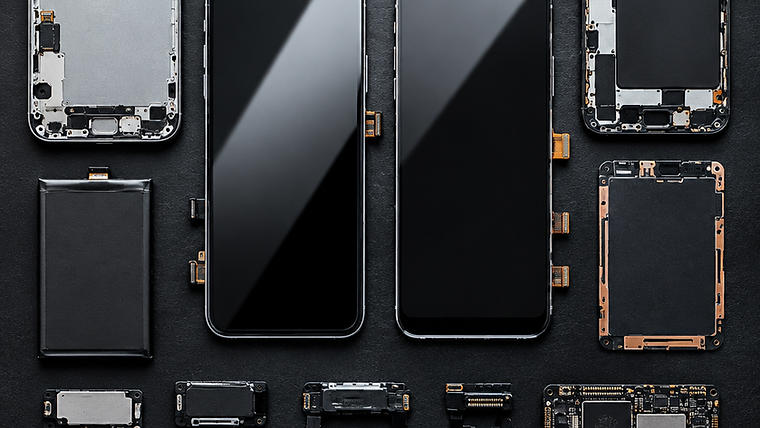
Faulty is a condition, not a verdict. Devices that no longer power on, screens with dead lines, boards with missing components and handsets with damaged chassis all still carry recoverable value. What separates a worthless pallet from a tradable one is usually information: what the units are, what state they are in, and what can realistically be recovered from them.
The three recovery routes
Component recovery. Boards, modules, cameras, connectors and screen assemblies are harvested and returned to service in repair and refurbishment operations. This route usually produces the highest return, because a working component is worth more than the material it contains.
Repair and refurbishment. Devices with a defined fault are repaired to a tested standard and returned to use. This route needs model families where parts are still available and where the repaired device has a market.
Materials recovery. What cannot be reused is directed to appropriate downstream processing so the metals, plastics and glass are recovered responsibly. This is the route of last resort, and it is a compliance obligation as much as a commercial one.
What makes a faulty lot tradable
- Volume and model families. A hundred units of a handful of models is workable. Ten units each of thirty models is a sorting project.
- Board-level completeness. Boards with components still attached trade differently from boards that have been picked over.
- Housings, frames and screen assemblies. Intact physical parts carry value independently of whether the device powers on.
- Locked or account-bound devices. If a device is locked, say so. It changes what can be recovered and it must not be bypassed.
- Battery condition. Swollen or damaged batteries change the handling, the paperwork and often the freight class.
- Age and parts availability. A recent model with a screen fault is a repair candidate. A fifteen-year-old device is a component and material lot.
Data security comes before logistics
Every faulty lot that contains storage has to be treated as a data-bearing lot until proven otherwise. A device that will not boot is not a device without data. Practical requirements:
- Erase or destroy storage using a documented, verifiable method before goods change hands
- Keep a record of the method and the serial numbers it was applied to
- Maintain chain of custody from collection to recovery
- Remove or account for SIM cards, memory cards and any external storage
Data handling is normally the first question an enterprise seller asks, and the first thing an asset disposition partner has to be able to evidence.
Compliance questions to settle early
Rules on electrical and electronic waste differ by country, and some categories are restricted or require notification for cross-border shipment. Before a faulty lot moves:
- Confirm the classification of the goods in the country of origin
- Confirm what the destination country will accept, and under what documentation
- Keep the export and recovery documentation with the transaction record
- Confirm that any downstream processor operates to the standard your contract requires
This is a general summary rather than legal advice. Requirements change, and they differ by jurisdiction, so confirm the current rules for the specific countries involved.
Grading language for faulty stock
- Faulty / For Repair - a defined fault, repairable with available parts
- Faulty / Untested - does not function, cause not established
- For Parts / Recovery - retained for component or material recovery
- Damaged - physically broken, value in remaining components and materials
- Incomplete - missing components, accessories or housings
State the fault where you know it. A lot described as faulty with the symptom attached, such as no power, cracked screen or boot loop, can be evaluated immediately. A lot described only as faulty cannot.
Frequently asked questions
Is it worth selling faulty devices rather than recycling them? Often, yes. Reuse and component recovery normally return more value than material recovery alone, and they keep working components in service. The exception is a lot so mixed or so degraded that sorting costs more than it returns.
Can faulty devices with data be sold? Only after the storage has been erased or destroyed using a documented method. Never rely on the device being broken as a data protection measure.
Do broken screens have any value? Yes. Screen assemblies, frames and intact housings are recovered even when the device itself is beyond repair, and used LCD and OLED assemblies are an active wholesale category.
The practical takeaway
Faulty electronics trade on specification and disclosure. Say what the units are, what is wrong with them, whether storage has been handled, and where they ship from. A well-described faulty lot competes for buyers. An undescribed one is priced as scrap.
Tell us what you have through the Sell Your Stock form and our trading desk will assess the recovery route that fits it.
Topics covered
- faulty electronics recovery
- IT asset disposition
- e-waste value recovery
- used LCD screens
- circular economy electronics
- faulty mobile devices
- component recovery