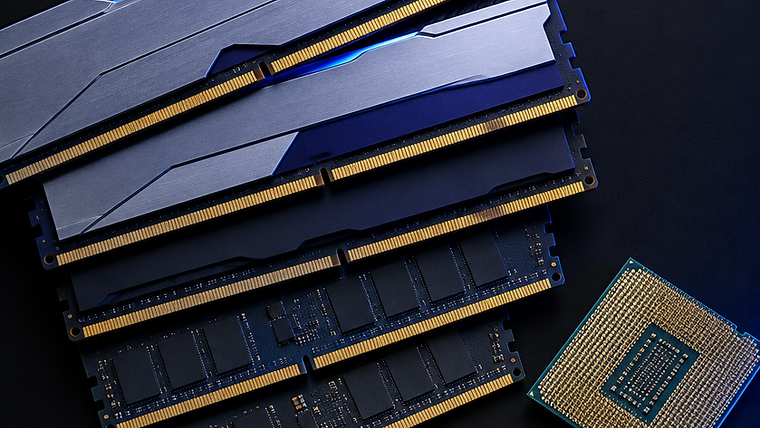
Memory is the most mis-quoted category in wholesale IT hardware. Two modules with the same capacity can differ several times over in value, because what matters is not how much memory sits on the module but which platforms it fits and how much of it is still wanted.
Module type decides the platform
A 32GB module is not interchangeable with another 32GB module:
- UDIMM - unbuffered, desktop and workstation platforms
- SODIMM - laptop and small form factor platforms
- RDIMM - registered, server and data centre platforms
- LRDIMM - load reduced registered, high density server platforms
Server memory and client memory have different buyers and different price levels. A lot described only as 32GB DDR4 forces the buyer to guess, and the guess will be conservative.
DDR4 and the installed base
DDR4 still carries the majority of installed server memory, and it will continue to trade for years because platforms that use it are still in service. Demand comes from refresh cycles, warranty replacements, capacity upgrades on existing fleets and refurbishment programmes.
DDR4 modules use the PC4 designation with the speed bin appended, for example PC4-2133P, PC4-2400T, PC4-2666V or PC4-3200AA. The suffix is not decoration. It identifies a specific speed grade, and mixing grades inside a lot changes how a buyer can resell it.
DDR5 and the transition
DDR5 arrived with newer server platforms and uses PC5 speed bins, from PC5-4800B upward through the faster grades. Modules carry on-module power management and, on server parts, ECC. DDR4 and DDR5 are not interchangeable: a platform takes one or the other, so a DDR5 lot is only useful to buyers who have demand for DDR5 platforms.
That matters commercially. During a platform transition a lot can be technically current and commercially thin, or older and still in strong demand from the installed base. Neither generation is automatically better to hold. Both are worth holding when the specification is precise.
The checklist to apply to every lot
- Generation: DDR3, DDR4 or DDR5
- Module type: UDIMM, SODIMM, RDIMM or LRDIMM
- Capacity per module
- Rank and organisation, for example 1Rx4, 2Rx4 or 2Rx8
- Speed bin and PC designation
- ECC and registered status
- Voltage and any platform-specific variant
- Manufacturer and full module part number
- Quantity and whether the modules are a matched set
- Test status and whether testing was per module or per sample
If a seller cannot answer most of this, the lot is still tradable, but it is priced as an unsorted lot rather than as specified stock.
Rank, density and matched sets
Rank describes how the memory chips on a module are organised and how the module presents itself to the memory controller. It affects which servers accept the module and how many modules can be populated per channel. Two modules with identical capacity and speed but different rank behave differently in a server, so rank belongs in the specification, not in a footnote.
Matched sets matter for the same reason. Modules that shipped together and were tested together are easier to deploy than an assortment assembled from different batches. A lot of matched sets is worth more to a data centre buyer than the same count of loose modules.
Test status and yield
Testing is what converts an unknown lot into a specified one. A typical approach is to test a sample, report the failure rate and price the whole lot on that basis. If a lot is tested per module, say so, because the assurance is stronger and the offer reflects it.
Untested memory is not untradable. It is simply valued with a higher assumed failure rate, which comes straight off the offer.
Pricing traps in memory trading
Applying single-unit retail prices to bulk. Retail pricing reflects retail demand and retail quantities. Wholesale offers have to absorb freight, testing, sorting and the fact that not every module will pass.
Treating RDIMM and UDIMM as one market. They are not. Demand for registered server memory comes from a different buyer set than demand for desktop modules.
Ignoring the speed bin. A slower bin inside the same generation can be materially harder to place than the mainstream bin.
Counting mixed modules as one quantity. A hundred modules across twelve part numbers is twelve small positions, not one large one.
Frequently asked questions
Is used server memory worth buying? It depends on the specification and the platform, not on the fact that it was used. Tested RDIMM and LRDIMM in current speed bins trade actively; the same capacity in an obsolete bin is usually valued as material rather than as product.
Should I test before selling? Testing is optional but it changes the offer. Sampling gives the buyer a failure rate to price against, which is nearly always better than an unknown.
Will DDR5 replace DDR4 demand immediately? No. Server platforms using DDR4 remain in service, and refresh cycles are gradual. Both generations trade, and buyers need supply of both.
The practical takeaway
In memory trading the specification is the product. Generation, module type, rank, speed bin, ECC and test status are what turn a pallet of modules into a quotable lot.
Submit a buying requirement or a stock list and our trading desk will respond with the specification questions that matter for that lot.
Topics covered
- bulk DDR4
- DDR5 wholesale
- server memory buyer
- ECC RDIMM
- memory module grading
- used server memory
- memory trading